

By Mary Ellen Mitchell
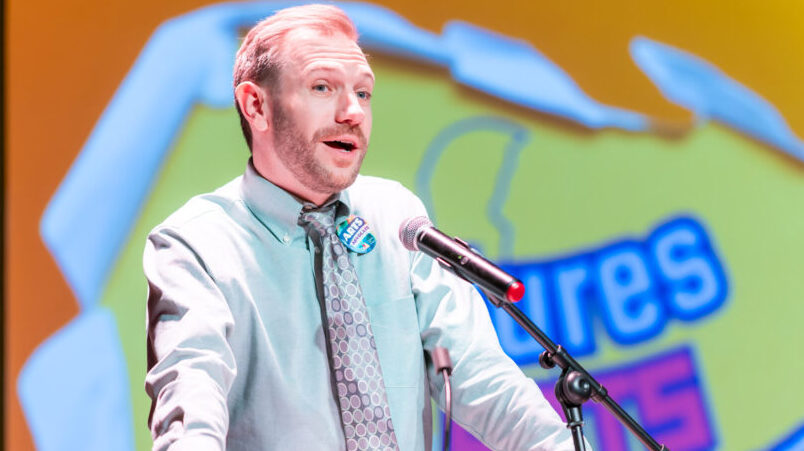
The arts can evoke a sense of wonder, shift perspectives, and enhance understanding and connection. In support of this tenet, Neil Kirschling, executive director of Delaware Arts Alliance (DAA), advocates on behalf of artists, arts and culture organizations and institutions, and patrons.
In addition to fostering well-being, the arts are a pillar of Delaware’s economy, generating about $3.7 billion annually and employing more than 10,000 residents. Kirschling believes DAA and its partners can boost these numbers — enough for the state to achieve worldwide recognition as an arts and culture destination.
Arts leaders from around the state are on the same page. Molly Giordano, executive director of the Delaware Art Museum, says, “Thriving metropolitan communities like Austin or Nashville are anchored by arts and culture, and that’s our big-picture plan for Delaware.”
The Power of Collective Advocacy
Founded in 2009, DAA is a nonprofit, statewide arts advocacy organization, representing members from 60 arts and culture organizations and institutions, and several hundred individual artists and small businesses. Kirschling oversees all aspects of the organization alongside his colleague, Jordan Resh, and 16 working board members.
Kirschling joined DAA in 2022 from Rodel, a nonprofit organization aiming to transform education policy and programs throughout the state. He notes that earning his bachelor’s degree in public policy and master’s in public administration from the University of Delaware has prepared him for challenges and opportunities throughout his career.
Just three years into his leadership role at DAA, “Neil has been brilliant,” Giordano says. “He’s thoughtful, collaborative, and calm, as he takes time to understand needs of the arts and culture sector, policymakers, and lawmakers. He has mastered such a difficult skill set.”
Kirschling is quick to pass along recognition. “Our members are the lifeblood of DAA,” he says. “Membership dues, although nominal, signal buy-in, which shows policymakers that DAA is organized and aligned and indicates to funders that the arts community doesn’t take funding for granted.
“Lawmakers can’t be experts in everything, so they rely on us to help them understand issues that are important to their constituents, while we track developments at the state and federal levels so that our members don’t have to get in the weeds.”
Drafting the Blueprint for Success
A key organizational ally of DAA has been the Arts and Culture Caucus, a bipartisan, bicameral group chaired by State Sen. Elizabeth Lockman and State Rep. Brian Shupe. The caucus organized in 2021 to determine the impact of COVID-19 on the arts and culture sector of Delaware’s economy.
In support of this effort, Kirschling’s predecessor at DAA, Jessica Ball, secured $1 million in federal funding under the American Rescue Plan Act that same year to direct a full-fledged study of the state’s creative economy. Ball went on to become executive director of the Delaware Division of the Arts (DDOA), where she continues to partner with DAA on a variety of initiatives.
When Kirschling took over for Ball in 2022, he selected the firm Sound Diplomacy to execute the study and develop a comprehensive report on Delaware’s arts and culture sector, entitled, the Creative Economy and Cultural Tourism and Growth (CREATE) Plan.
As the CREATE Plan was being developed, legislators began implementing its early recommendations — one of which was to expand equitable arts funding.
To this end, Kirschling and advocates inside and outside of state government collaborated with leaders in the executive branch to align their goal. It led to a historic legislative win for the arts and culture sector: The DDOA received a budget increase of $1 million for fiscal 2024, the first boost to the state arts budget since 2014.
More efforts led to a $1 million increase for fiscal 2025, and a $500,000 increase for fiscal 2026, for a total of $2.5 million over the past three years, enabling DDOA to cover existing grant program costs and support new grantees.
Another CREATE Plan recommendation calls for more art career pathway courses and associates degrees. Progress has already begun. This year, members of the Arts and Culture Caucus, with DAA support, drafted and passed Senate Concurrent Resolution 109. This piece of legislation directs Delaware’s Departments of Education and Labor to recommend ways to increase art career and technical education programs.
Regarding Delaware’s young artists, the CREATE Plan found that they often leave the state in search of larger markets, especially in art science fields, such as gaming design, media production, and filmmaking. DAA is working with policymakers to determine how to keep young talent in the First State.
Kirschling unveiled the final CREATE Plan to the state legislature in January 2025. Although it was well received, he shies away from taking credit. “Jessica procured the dominos,” he says. “I just set them up and knocked them over.
“We hope the CREATE Plan will serve as a North Star for Delaware’s arts and culture sector for many years to come.”
Surveilling The Landscape
DAA relies primarily on two resources to watch for developments with potential impact on the arts and culture sector:
The first is a bimonthly convening hosted by Lt. Gov. Kyle Evans Gay, in which legislators and art and culture sector employees meet virtually to discuss creative economy issues. Kirschling aligns discussion outcomes with CREATE Plan recommendations to support and track implementation.
The second is a membership with Americans for the Arts (AFTA), a Washington, D.C.-based organization for which Kirschling serves as Delaware’s state captain.
“Much like I do for our members, AFTA will tap me on the shoulder when there’s an opportunity for DAA to get involved at the federal level, where we’ve been engaged in ongoing advocacy to protect the National Endowment for the Arts,” he says.
Performing With Passion
Kirschling views his leadership role as the ideal intersection of his experience and aspirations. His background in public policy and advocacy complements his lifelong passion for singing in local choirs and a cappella ensembles, and singing, acting and dancing in plays and musicals at local venues.
Colleagues are quick to sing his praises. According to Ball, who has become more of a friend than a colleague to Kirschling over the years, “I’ve seen Neil perform many times, and he’s absolutely amazing.”
DAA Board President Matt Silva, director of campaign management for Nemours — who previously served as artistic director for Delaware Theatre Company — echoes Ball’s five-star review. Silva recently saw Kirschling perform as a featured ensemble member in the musical Something Rotten! at Candlelight Theatre in Arden. “His crisp, clean energy and nuance make the whole thing work,” he says.
“Between his accomplishments with DAA, performing for months at a time, and other personal pursuits like playing tennis at a high level, I’m not sure how he does it all,” Silva says.
While Kirschling brings an artist’s perspective to his work, he says voicing the interests of DAA members is equally exciting and fulfilling.
“The ultimate success, for me, will be that DAA exists well beyond my time, and that it maintains the trust we’ve built within the arts community,” he says.
— As implementation of CREATE Plan recommendations continues to progress, DAA will begin highlighting detailed outcomes starting next month. To learn more, visit DelawareArtsAlliance.org/stateofCREATE
Above: Neil Kirschling at the Futures in Art celebration at the Smyrna Opera House in May. Photo Courtesy Delaware Arts Alliance.